

Sea Container Storage vs Traditional Storage Buildings
WestWay Storage uses steel sea containers, the same units built to move cargo across oceans as the foundation for every storage unit at our Seminole facility. That wasn’t an arbitrary choice. West Texas punishes standard construction in ways that show up fast: blowing dust that finds every gap, winds that stress metal panels, and heat cycles that age materials quickly. Sea containers were engineered to survive worse. Here’s what that means for what you’re storing.
Why Steel Sea Containers Beat Traditional Storage Construction
Standard self-storage facilities are built to a price point. Light-gauge corrugated steel panels over a metal stud frame, roll-up doors with moderate seals, and a structure that depends on interior framing to hold its shape. That construction works acceptably in mild climates. It underperforms in environments with high winds, heavy dust, or significant thermal cycling.
Sea containers were engineered to a different standard stacked on ships, exposed to salt air and ocean weather, and expected to maintain structural integrity across decades. The key differences:
Steel gauge: Shipping container walls are heavier-gauge corten steel, not the thinner panels used in portable storage buildings. The steel forms a stable oxide layer that resists corrosion without ongoing treatment.
Welded seams, not panel joints: Prefab buildings are assembled with overlapping panels and fasteners. Containers are welded. There are no panel gaps for dust, moisture, or pests to migrate through over time.
Self-supporting structure: A container’s integrity doesn’t depend on its foundation or interior framing. It holds shape independently, which matters in high-wind environments where paneled buildings rack and stress at their connection points.
Gasketed doors: Container doors seal against a rubber gasket when closed — the same approach used for weathertight cargo transport. Standard storage doors, including most roll-ups, don’t seal to that standard.
The result is a storage unit that performs at the same level in year ten as it does in year one, without accumulated wear at seams and door frames.
Sea Container Storage vs Traditional Storage Buildings
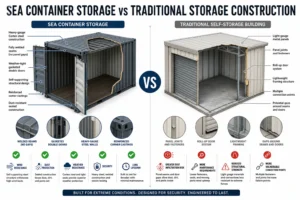
| Feature | Sea Container | Traditional Metal Building | Wood-Frame Building |
| Construction | Heavy-gauge corten steel, fully welded, self-supporting | Light-gauge steel panels on metal frame | Wood framing, metal or wood cladding |
| Wind Resistance | Engineered for maritime stacking and lateral loads; structurally independent | Panel-dependent; susceptible to racking under sustained lateral load | Lowest resistance; vulnerable to high winds |
| Dust Protection | Welded seams and gasketed doors eliminate infiltration points | Panel joints and door gaps allow dust migration over time | Highest infiltration risk; wood shrinkage creates additional gaps |
| Weather Resistance | Designed for rain, humidity, and salt air; resists moisture intrusion | Adequate in mild climates; coating-dependent | Requires ongoing maintenance to prevent moisture damage |
| Pest Resistance | No organic materials; sealed floor, walls, and doors | Metal reduces risk but panel gaps allow entry | Highest risk; wood provides both nesting material and entry points |
| Security | Heavy steel doors with recessed hasp; structural walls resist forced entry | Lock quality varies; lighter door construction | Weakest; vulnerable at door frames and panel connections |
| Longevity | 20–30+ years without structural degradation | 10–20 years with maintenance | 10–15 years with consistent upkeep |
| Maintenance | Minimal; cosmetic only | Periodic panel, fastener, and seal inspection | Highest; painting, sealing, and structural checks required |
| Access | Double swing doors; full-width opening | Single roll-up or swing door standard | Single door standard |
How Sea Containers Handle Dust, Wind & Heat
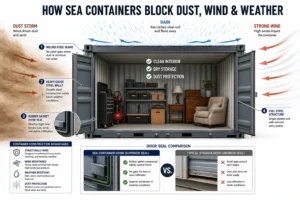
Dust is the most underestimated storage threat in dry, high-wind regions. A single dust event can deposit enough particulate to damage electronics, contaminate tools, and degrade anything stored without hermetic sealing. Sea containers address this structurally: the body is welded, not paneled, and the doors gasket-seal when closed. There are no seam gaps for dust to infiltrate over months of use.
Wind is a structural concern, not just a nuisance. Prefab storage buildings depend on their anchor systems and frame connections to stay rigid under lateral loads. Sea containers are a monolithic steel box wind doesn’t find purchase the way it does on paneled construction. The reinforced corner castings, structural roof, and welded body act as a single unit under load.
Heat and thermal cycling age materials through repeated expansion and contraction, stressing fasteners, pulling seams apart, and degrading weatherstripping. Corten steel was developed specifically to resist thermal fatigue and surface oxidation. It does not require recoating cycles to maintain its resistance; the oxide layer is the protection, not a coating on top of it.
In climates with all three dust, wind, and heat the compounding advantage of sea container construction over prefab alternatives is significant.
Double-Door Access: What It Actually Changes
Every sea container unit opens with double swing doors across the full width of the container face. This is a functional difference, not a cosmetic one.
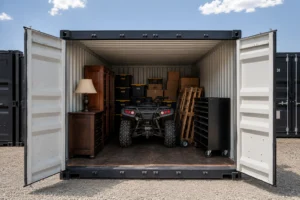
Standard roll-up doors limit loading based on their opening width and require unloading from a single direction. Double doors give you the full container opening:
- Furniture, equipment, and oversized items load without rotation or repositioning
- You can access the back of the unit without moving everything staged at the front
- Two people can load simultaneously without interference
- Pallets, equipment on wheels, and wide cargo stage cleanly at the door threshold
The doors lock with a heavy steel hasp designed for padlock attachment. The hasp is recessed into the door face rather than surface-mounted, which removes the leverage point that pry attacks rely on. You supply the lock; the door design doesn’t compromise it.
Who Benefits Most From Sea Container Storage
Sea container storage isn’t the right fit for every situation items requiring climate control belong in a climate-controlled environment regardless of the unit’s construction. For everything else, here’s where the advantages matter most:
Contractors and tradespeople need units that can absorb regular loading, handle heavy equipment without floor damage, and keep tools and materials free of dust and moisture between jobs. The structural floor and sealed body serve that use case better than standard units.
Oilfield and industrial workers often store sensitive instruments, motors, and electronic components that can’t tolerate dust infiltration. Standard panel-gap construction introduces risk that sea containers eliminate at the structural level.
Farmers and ranchers storing seed, chemical supplies, or equipment parts need protection from pests and moisture without ongoing maintenance requirements. The sealed floor and walls remove the ground-contact infiltration risk.
Homeowners and small businesses moving, renovating, or managing overflow inventory benefit from knowing the unit won’t introduce new damage to what they’re storing. The construction handles weather without requiring the renter to work around its limitations.
At WestWay RV & Self Storage in Seminole, Texas we made the decision to build our facility on steel sea containers specifically because West Texas conditions sustained high winds, persistent dust storms, and intense heat cycles expose the weaknesses of standard storage construction faster than anywhere. The sea container units at WestWay have performed without the seal degradation, dust infiltration, and structural stress that comparable prefab facilities in the Permian Basin show within a few years of construction.
FAQs
What is sea container storage?
Individual storage units built from intermodal shipping containers, the heavy-gauge steel units used for ocean freight. The container is the unit: structural walls, sealed floor, gasketed doors, and welded seams included.
Are sea container storage units weatherproof?
Yes. Welded construction and gasketed doors prevent rain, moisture, and debris infiltration. They are not climate-controlled interior temperature tracks ambient conditions but they don’t leak or allow moisture entry under normal operating conditions.
Do sea containers keep out dust?
Better than any standard storage construction alternative. The gasketed door seal and welded body eliminate the infiltration points that allow dust migration through standard panel-joint buildings over time.
Are sea container storage units secure?
Heavy-gauge steel doors with a recessed hasp provide meaningfully stronger security than light-gauge metal or wood-frame construction. The structural walls are not accessible with standard hand tools.
How do sea containers compare to traditional storage buildings?
Heavier construction, tighter seals, stronger doors, longer lifespan, and lower maintenance. The trade-off: no climate control, and interior temperature reflects outside conditions.
Are they easy to access?
Double swing doors open across the full container width, which is easier for large or bulky items than standard roll-up doors.
What can be stored inside?
Furniture, appliances, equipment, tools, inventory, vehicles (in appropriately sized units), seasonal items, and household goods. Anything requiring temperature control is not a good fit for non-climate-controlled storage of any type.
Why do some storage facilities choose sea containers over traditional buildings?
Because sea container construction outperforms standard storage building design in high-stress environments. Dust infiltration, wind load, and thermal cycling reveal the weaknesses of prefab construction faster in demanding climates. Sea containers were built to withstand conditions that standard storage buildings were not designed for.
Rent Your Sea Container Storage Unit Today
WestWay Storage is locally operated in Seminole, Texas. Our units are on-site and available now with no waiting list, no construction delays.
If you’re comparing options, we’re confident the construction speaks for itself. If you have questions about sizing or what fits your specific use case, check the sizing page or call us directly.
Rent Now →
View Sizes & Pricing →


