

How to Choose the Right Storage Unit Size?
Renting the wrong size storage unit is one of the most common and avoidable storage mistakes. Too small, and you’re either cramming belongings dangerously or paying for a second unit. Too large, and you’re paying $30–$80 per month for empty air. Getting the size right before you sign a rental agreement saves money, prevents damage to your belongings, and makes access far easier over time.
This guide gives you a straightforward sizing framework: a quick-reference calculator, detailed breakdowns of every standard unit size, a pre-rental checklist, and practical tips for maximizing whatever space you choose.
Why Storage Unit Size Matters
The financial case is simple: most facilities charge per square foot, so oversizing by even one unit tier typically costs $20-$50 more per month, $240-$600 over a year. But there are operational reasons too:
- Correct sizing allows you to create an organized layout with labeled boxes accessible from a center aisle
- An overcrowded unit puts weight stress on boxes at the bottom and increases the risk of moisture damage from restricted airflow
- Undersized units often mean belongings end up stacked in front of the door, making monthly retrieval a full unpack-and-repack exercise
- Properly sized units reduce the time you spend accessing your belongings by 30–50% compared to overpacked units
The goal isn’t the smallest possible unit, it’s the unit that holds everything comfortably while leaving enough working space to actually use the storage.
Quick Storage Unit Size Calculator
Match your situation to the recommended unit size. These are starting points; adjust up if you have oversized furniture or plan to add items within 12 months.
| Situation | Recommended Size | Why This Size |
|---|---|---|
| Studio or small apartment (up to 500 sq ft) | 5×10 or 10×10 | Light furniture load; 1–2 rooms of contents |
| 1-bedroom apartment or home | 10×10 | Standard bedroom + living room contents fit cleanly |
| 2-bedroom home | 10×15 | Adds a second bedroom set; appliances usually need this tier |
| 3-bedroom home | 10×20 | Full household including washer/dryer, dining set, multiple bedroom sets |
| 4-bedroom home or full estate | 10×30 or sea container | Large volume; furniture from 4+ rooms plus garage overflow |
| Business inventory (retail/office) | 10×10–10×20 | Depends on pallet count and shelving needs |
| Contractor tools and equipment | 10×15–10×20 | Tool chests, compressors, lumber, and seasonal gear |
| Agricultural or oilfield equipment | 10×30, sea container, or RV parking pad | Large items that don’t fit standard unit doorways |
| RV or camper (under 25 ft) | RV parking with hookups | Units can’t accommodate RVs; see dedicated RV storage |
| Seasonal storage only (holiday decor, lawn equipment) | 5×5 or 5×10 | Limited volume; these items stack well vertically |
Storage Unit Size Comparison Guide
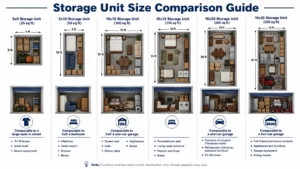
Every storage facility uses slightly different pricing, but the capacity logic below applies universally. Ceiling height at most facilities runs 8-10 feet factor into your vertical stacking plan.
5×5 Storage Unit
| Attribute | Detail |
|---|---|
| Square footage | 25 sq ft |
| Volume (8 ft ceiling) | ~200 cubic feet |
| Comparable space | Large walk-in closet |
| Typical contents | 10–15 medium boxes, small furniture (nightstand, bar stools, small shelving unit), seasonal decor, sports gear |
| Best for | Dorm room overflow, holiday storage, small business document archive, short-term staging |
| Storage tip | Stack boxes to 6 feet; keep heavier boxes on the bottom. A small wire shelving unit doubles usable volume. |
5×10 Storage Unit
| Attribute | Detail |
|---|---|
| Square footage | 50 sq ft |
| Volume (8 ft ceiling) | ~400 cubic feet |
| Comparable space | Large walk-in closet or half a standard bedroom |
| Typical contents | Contents of a studio apartment: twin or full mattress, small couch, dresser, 20–30 boxes |
| Best for | Studio apartment move, college student storage, single-room staging during renovation |
| Storage tip | Stand the mattress vertically against the back wall to free up floor space for furniture and boxes. |
10×10 Storage Unit
| Attribute | Detail |
|---|---|
| Square footage | 100 sq ft |
| Volume (8 ft ceiling) | ~800 cubic feet |
| Comparable space | Half a standard single-car garage |
| Typical contents | 1–2 bedroom apartment contents: queen bed, sofa, dining table with chairs, dresser, washer or dryer, 30–50 boxes |
| Best for | 1-bedroom apartment move, renovation staging, office furniture storage, small business inventory |
| Storage tip | Disassemble bed frames and tables; this frees 15–20 sq ft for boxes. Store appliances against the back wall first. |
10×15 Storage Unit
| Attribute | Detail |
|---|---|
| Square footage | 150 sq ft |
| Volume (8 ft ceiling) | ~1,200 cubic feet |
| Comparable space | Three-quarters of a standard single-car garage |
| Typical contents | 2-bedroom home contents including both bedroom sets, full living room, washer and dryer, dining room, 40–60 boxes |
| Best for | 2-bedroom home move, contractors storing tools and materials between jobs, business inventory with pallet shelving |
| Storage tip | Leave a 24-inch center aisle from door to back wall. Without an aisle, items at the back become inaccessible within weeks. |
10×20 Storage Unit
| Attribute | Detail |
|---|---|
| Square footage | 200 sq ft |
| Volume (8 ft ceiling) | ~1,600 cubic feet |
| Comparable space | Standard single-car garage |
| Typical contents | 3-bedroom home: three bedroom sets, full living and dining room, washer/dryer, refrigerator, 50–80 boxes, and a small riding mower |
| Best for | 3-bedroom home move, long-term household storage, mid-size business inventory, contractor material storage |
| Storage tip | Use the rear half for furniture and appliances; front half for shelved boxes. This maintains access without moving large items. |
10×30 Storage Unit
| Attribute | Detail |
|---|---|
| Square footage | 300 sq ft |
| Volume (8 ft ceiling) | ~2,400 cubic feet |
| Comparable space | Standard two-car garage |
| Typical contents | Full 4-bedroom home including large appliances, garage contents, and outdoor equipment; or large contractor/oilfield equipment loads |
| Best for | Estate storage, large home transitions, full commercial inventory, agricultural equipment that fits standard door openings |
| Storage tip | At this size, a hand truck and furniture dolly are essential. Pre-map your layout before moving items in — reorganizing a 10×30 without a plan wastes hours. |
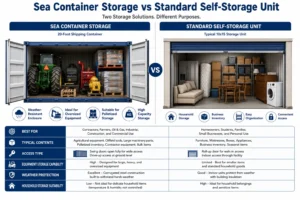
For oversized equipment, machinery, or vehicles that exceed standard unit door heights (typically 8 feet), sea container storage and RV parking with electrical hookups handle what standard units cannot. Sea containers at WestWay RV & Self Storage in Seminole offer weather-resistant storage for high-value equipment at agricultural or oilfield operations.
Storage Unit Size Checklist Before Renting
Work through this before contacting any facility. The more accurately you complete it, the less likely you are to rent the wrong size.
Count and Categorize Your Furniture
List every large item: beds (note size), sofas, dressers, dining sets, desks, bookshelves. Count separately from boxes, furniture volume is the primary driver of unit size, not box count.
- List all beds and note mattress size (twin, full, queen, king)
- Count sofas, sectionals, and loveseats
- List appliances (refrigerator, washer, dryer, chest freezer)
- Note dining table and chair count
Measure Unusually Large Items
Sectional sofas, king-size beds, and tall armor frequently determine unit width requirements. A sectional that measures 120″ wide will not pass through a 5-foot unit door and cannot be split efficiently. Measure length and width before assuming a smaller unit works.
- Measure sectional sofa total width when assembled
- Measure armoire or wardrobe height against ceiling clearance
- Confirm refrigerator depth fits planned storage position
Estimate Box Quantity
A standard medium moving box (18″×14″×12″) holds about 1.75 cubic feet. As a rule of thumb: one room of packed belongings equals 20–30 medium boxes. Count your rooms, multiply by 25, and divide by 200 to estimate the number of 5×5 units’ worth of box volume you’ll have.
- Estimate box count per room
- Account for boxes in garage, attic, and basement
Plan for an Access Aisle
Budget 30% of the unit’s floor space as a working aisle. For a 10×10 (100 sq ft), that means planning to fill only 70 square feet with items. If your inventory requires 95 square feet of floor coverage, step up to a 10×15.
- Confirm planned unit allows 24″ aisle from door to back

Account for Future Additions
If you’re downsizing a home, staging for a sale, or storing during a long-term construction project, you may bring more items over the rental period. Renting one tier larger upfront is cheaper than upgrading to a second unit later.
- List any items you plan to add to storage within 6 months
- Note any seasonal items (lawn equipment, holiday decor) going in/out
Confirm Vehicle and Equipment Storage Needs
If any item has wheels RV, trailer, ATV, boat, work truck, farm equipment verify unit door width and height before reserving. Most standard units have 8-foot roll-up doors. Many vehicles and equipment require outdoor RV parking pads or sea container storage instead.
- Measure vehicle length and height
- Confirm facility door clearance for oversized equipment
Common Mistakes When Choosing a Storage Unit
- Renting based on room count alone: Two people in a 2-bedroom apartment may have half the furniture of a family downsizing from a 2-bedroom house with 15 years of accumulated belongings. Room count is a starting point, not a decision.
- Skipping the aisle: Filling a unit to capacity without an aisle means you’ll move everything to reach the box at the back. Many renters end up using only 20% of their stored items because the rest is inaccessible.
- Ignoring ceiling height: An 8-foot ceiling adds 60–100% more usable volume when you use proper shelving or stack correctly. Most renters use only the bottom 4 feet of the unit.
- Not disassembling furniture: A king-size bed frame assembled takes 42 sq ft of floor space. Disassembled and stacked, it takes less than 8 sq ft. Disassemble anything with legs.
- Forgetting irregularly stored items: Holiday decor, camping gear, and seasonal lawn equipment are often overlooked during the estimation process. These typically add 5×5 to 5×10 of additional volume.
- Assuming the smallest available unit is the cheapest long-term: Renting a unit that forces you to leave items in a second location (or in a truck for extra days) is almost always more expensive when total costs are calculated.
Storage Tips to Maximize Your Unit
- Install wire shelving along one wall immediately it removes boxes from the floor, protects them from moisture, and doubles vertical capacity
- Disassemble all bed frames, dining tables, and desks before storing; store hardware in labeled zip-lock bags taped to the item
- Fill dresser drawers with soft items (linens, clothing) before storing drawers that are emptied waste usable volume
- Stack boxes heaviest on the bottom, lightest on top; never stack more than 5 boxes high without shelving support
- Label boxes on the side (not the top) so labels are visible when stacked
- Store items you’ll access most frequently within 3 feet of the door
- Use wardrobe boxes for hanging clothes rather than folding garments into standard boxes; this eliminates ironing and preserves delicate items
- For long-term storage exceeding 6 months, leave 2 inches of clearance between items and exterior walls to allow airflow
Choosing Storage in Seminole, TX and West Texas
Storage needs in Gaines County and the surrounding West Texas region have a different profile than urban markets. Agricultural operations, oilfield contractors, and RV travelers represent a large share of local storage users and their needs often exceed what standard self-storage units offer.
WestWay RV & Self Storage at 189 CR 307 in Seminole offers a range of unit sizes alongside options that accommodate the specific demands of this area:
- Self-storage units in standard sizes for household, residential, and business inventory
- Sea container storage for large equipment loads, agricultural inventory, or high-value oilfield gear requiring weather protection
- RV parking with electrical hookups for travelers, seasonal residents, and RV owners who need more than dry storage
- Vehicle and equipment storage for trucks, trailers, and work equipment
For Seminole residents in the middle of a move or home renovation, a 10×10 or 10×15 unit handles most single-family household staging needs. Contractors working Gaines County projects commonly use 10×15 or 10×20 units for tools and materials. If you’re unsure which option covers your situation, the team at WestWay can help you match the right unit type to your actual inventory.
FAQs
What size storage unit do I need for a 1-bedroom apartment?
A 10×10 unit (100 sq ft) handles most 1-bedroom apartment contents: a queen bed, sofa, dining set, dresser, and 30-40 medium boxes. If you have a large sectional or multiple large appliances, consider a 10×15.
Is a 10×10 storage unit enough for a full house move?
Only for smaller homes. A 10×10 works for a 1-bedroom apartment or a very minimally furnished 2-bedroom. Most 2-bedroom home moves require a 10×15, and 3-bedroom homes typically need a 10×20.
How do I estimate storage space if I haven’t started packing?
Walk through each room and count: beds, sofas, large appliances, dressers, tables, and estimate boxes at 25 per room. Add 20% for garage or attic overflow. Cross-reference against the calculator table above.
Can I store business inventory in a self-storage unit?
Yes. A 10×10 with wire shelving works well for retail inventory, office supplies, or document archives. For pallet storage or larger inventory volumes, a 10×20 or 10×30 with drive-up access is more practical.
What size unit is best for furniture from a 3-bedroom home?
A 10×20 fits most 3-bedroom household contents including bedroom sets, living and dining room furniture, and major appliances. If the home has a full garage or workshop, step up to a 10×30.
How much fits in a 10×20 storage unit?
Approximately 1,600 cubic feet equivalent to a one-car garage. That typically includes three bedroom sets, a full living room, dining room, washer/dryer, refrigerator, and 50-80 boxes.
Is RV storage different from self-storage?
Yes. RVs, campers, and motorhomes don’t fit inside standard self-storage units due to height and length restrictions. They require outdoor parking pads, covered RV parking, or large drive-through storage. WestWay RV & Self Storage offers RV parking with electrical hookups, which also allows you to maintain batteries and run systems without transporting the RV to a power source.
What should not be stored in a self-storage unit?
Standard storage agreements prohibit: flammable or explosive materials (fuel, propane, ammunition), perishable food, live animals, and hazardous chemicals. Items that emit strong odors or attract pests should also stay out including unsealed food containers, wet wood, and uncleaned grills.
Can I store a boat or ATV in a standard self-storage unit?
Boats over 14 feet and most ATVs exceed unit door dimensions or require more clearance than a standard unit provides. A 10×20 or 10×30 with a tall door can sometimes fit a small boat on a trailer; confirm door height with the facility before reserving.
How do I know if I need a sea container instead of a unit?
If you’re storing large equipment with irregular dimensions, high-value machinery that needs weatherproof enclosure, or items that require forklift loading, a sea container is likely the better fit. Sea containers are also useful when you need storage at a remote work site rather than at the facility itself.
Should I rent one large unit or two small ones?
One large unit is almost always cheaper and easier to manage than two smaller ones. The only exception is when your items need to be stored in separate locations for access reasons, or when you need two different access types (e.g., a climate-sensitive unit for electronics plus a drive-up unit for furniture).
Determining Your Unit Size: Key Takeaways
The right unit size comes down to three factors: the volume of your largest furniture pieces, your total box count, and whether you need an access aisle. Most people consistently underestimate the impact of leaving a working space plan for it from the start.
Before contacting any storage facility, complete the checklist above and match your inventory to the size calculator. It takes 15 minutes and eliminates the most expensive storage mistake people make.
If you’re in Seminole, Gaines County, or the surrounding West Texas area and want to confirm sizing before renting, WestWay RV & Self Storage offers self-storage units, sea container storage, and RV parking with hookups at 189 CR 307 in Seminole, TX. Explore available unit sizes or reach out to discuss your specific storage situation.


